A retaining wall looks simple — stack the units, backfill, done. But in Northern Nevada, that simple-looking structure is fighting a relentless enemy: the freeze-thaw cycle. Water that collects behind a wall freezes, expands, and pushes with enormous force; thaw, refreeze, and repeat, season after season, and a poorly built wall bulges, cracks, and leans. Almost every failed wall we're called to repair has the same root cause.
Here's what actually makes a wall last here.
The real enemy: trapped water
Freeze-thaw damage isn't about the cold itself — it's about water. When water is trapped in the soil behind a wall and freezes, it expands roughly nine percent and exerts tremendous pressure on the structure. Do that hundreds of times over a few winters and even a heavy wall gives way.
The entire strategy for a durable wall, then, is getting water out from behind it before it can freeze and push. Everything else follows from that principle.
Start with the base
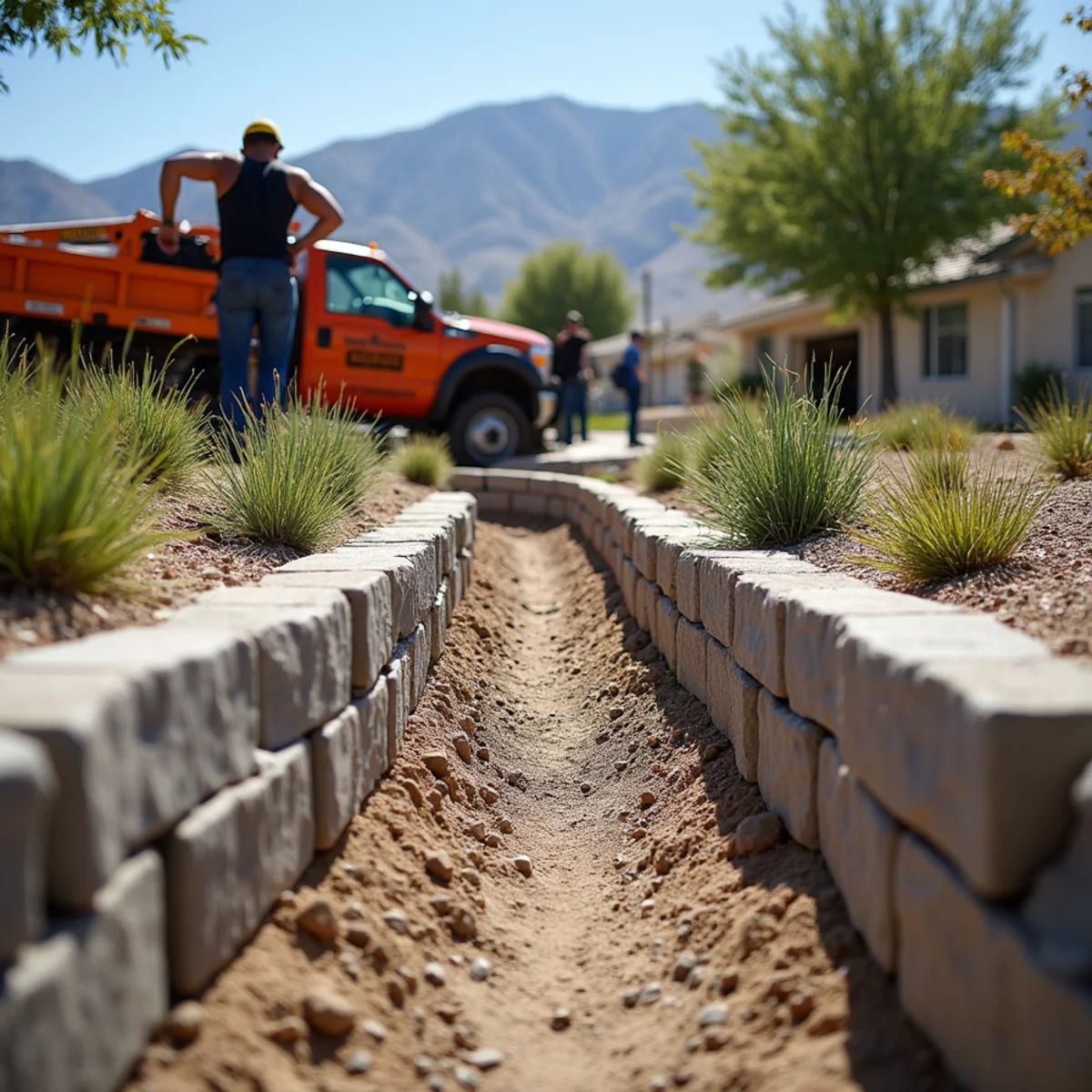
A wall is only as good as its footing. That means excavating a level trench, compacting the base, and setting the first course dead level on a compacted aggregate base. A first course that's off will telegraph errors all the way up, and a base that isn't compacted will settle unevenly.
This unglamorous first step is what separates a wall that lasts five years from one that lasts fifty.
Build in drainage
These drainage details are the difference-maker. They give water an easy path out so it never builds the hydrostatic pressure that wrecks walls in our climate.
- Free-draining aggregate (drainage rock) placed behind the wall, not native soil
- A perforated drain line at the base where the grade calls for it, daylighting to a lower point
- Backfill compacted in lifts so the soil is stable and doesn't settle
- Grading at the top so surface water sheds away from the wall rather than pooling behind it
Reinforcement and permits
Taller walls need reinforcement — geogrid layers tied back into the soil mass — and may require engineering. In the Carson City area, retaining walls not over four feet are generally exempt from permitting unless there's a surcharge (like a driveway loading the top) or liquid conditions, while some scopes reference lower thresholds. Height, engineering, and jurisdiction all change the answer.
A wall built on these principles holds its line through decades of Nevada winters. Pacheco Enterprises LLC builds engineered block and natural boulder walls with full drainage detailing across Carson City and Kingsbury. Call (323) 606-0255 for an estimate.
Pro insight: the drainage details that outlast the wall
We get called to fix leaning walls far more often than we get called to build new ones, and the failed walls almost always share one missing detail: free-draining backfill. Someone stacked the block on a decent base but backfilled with the native clay-heavy soil, which holds water against the wall until it freezes and pushes.
The fix is boring and invisible, which is why cheap builds skip it: drainage rock behind the wall, a perforated drain line that daylights to a lower point, and backfill compacted in lifts. Do that, and the freeze has nowhere to build pressure. Skip it, and no amount of nice capstone saves the wall.
- Backfill with drainage rock, never native clay soil, against the wall
- Run a perforated drain line at the base that daylights downhill
- Compact backfill in lifts, not one big dump
- Grade the top so surface water sheds away, not behind the wall
The bottom line
A wall lives or dies on the parts you can't see: a compacted base, drainage rock, a drain line, and backfill compacted in lifts. Get those right and the freeze has nowhere to build pressure; skip them and no capstone saves it.
Pacheco Enterprises LLC builds engineered block and natural boulder walls with full drainage detailing across Carson City and Kingsbury. Call (323) 606-0255 for an estimate that specifies the base and drainage, not just the block.
Frequently Asked Questions
With a compacted base, drainage rock, a drain line, and proper backfill, a segmental or boulder wall can last decades through Northern Nevada freeze-thaw. The base and drainage — not the block — determine its lifespan.
It depends on how far it's moved and why. Minor issues can sometimes be corrected, but a wall failing from missing drainage usually needs rebuilding with proper detailing. We'll assess and give you an honest answer.
Taller or surcharge-loaded walls may require engineering and a permit. Carson City generally exempts walls not over four feet unless a surcharge or liquid conditions apply. We confirm before building.
Related services & areas